Showing posts with label Treblinka. Show all posts

Saturday, February 20, 2010

Mr. Gerdes drives another nail into the "Revisionist" coffin

On the "CODOH Revisionist Forum" (where my account has not yet been reactivated even though the one-month period of the ban decreed on 19.01.2010 has already expired; I have sent an e-mail to the moderator requesting reactivation), my old friend Greg Gerdes accomplished something extraordinary for his low intellect and character.


After again repeating his simian "locate/prove the existence of just one mass grave containing 1/xth of y% of the alleged mass murder at z extermination camp" - hollering (see here and here), and having apparently realized that his fellow true believers didn't give a fuck anymore about this nonsense (last commented by me here), he opened a thread called jews, Transit Camps and the Soviet Gulag. On this thread, after briefly repeating his mendacious "not so much as one single grave [snip blah, blah, blah]" - mantra, he tried to provide evidence (yes, believe it or not: Gerdes tried to provide evidence!) that the Jews deported to "the fraudulently alleged 'pure extermination centers'", which "were in fact transit camps" (i.e. the at least about 1,517,500 Jews deported to Chelmno, Belzec, Sobibor and Treblinka, thereof ca. 152,000 to Chelmno, 434,500 to Belzec, 150,000 to Sobibor and 781,000 to Treblinka, see my RODOH post # 11878) ended up in the Soviet Gulag and perished there.

Considering Greg Gerdes'private standards of evidence as concerns Nazi crimes, which obviously require not only physically locating and establishing the dimensions of the mass graves and the quality of their contents (that has been done by archaeological investigation regarding all aforementioned camps except Treblinka, where Polish criminal investigators found a large area covered by human remains and established the depth of at least one mass grave, but did not determine the precise location and dimensions of each grave - see my RODOH post # 11879), but also physically locating and quantifying the human remains contained in each grave, one would expect the evidence for Gerdes' "The real jewish holocaust - by Soviet Gulag" - case to consist wholly or mainly of physical evidence to the burial of enormous numbers of Jewish bodies at the site of former Gulag camp complexes like Kolyma and Vorkuta.

What we get instead is this:

I would like to present, as exhibit # 1 for this thread - Aleksandr Solzhenitsyn's book - The Gulag Archipelago. If you haven't read this book yet, you don't know the holohoax. It will give you answers for things that you didn't even know there were questions about.

And for exhibit # 2, I give you:


Surviving the Camps but Struggling in Brooklyn

New York Times, January 21, 2010

By JENNIFER MASCIA


Ruth Usherenko keeps an improbably thick book on a table beside the couch in her living room. In it are roughly 58,000 names, all belonging to Jewish Berliners who perished during Hitler's regime. "All my girlfriends, all my relatives, all my neighbors are in here,"

...Beside her sat her sister, Toni Usherenko, 85, equally diminutive and delicate, who spoke in the same halting hybrid of Russian and English. The two live a block apart in Brighton Beach, Brooklyn, maintaining a closeness forged during World War II and later in a Siberian prison camp...

The sisters spent their early years in Neustrelitz, a town in northern Germany. After their father, a tailor, became a target of Nazi intimidation, the family moved to Berlin...

The girls' father was badly beaten in the riot, suffering a heart attack and a damaged kidney. Three years later, he was taken to Sachsenhausen concentration camp, where he perished.

Weeks after their father was apprehended, Ruth, Toni and their mother were taken to Gross-Rosen , a work camp...

In 1945, the three women were sent by the Soviets to a labor camp in Siberia; they were considered suspect because of their religion and their German provenance.

"We couldn't speak one word of Russian," Ruth Usherenko recalled. "They didn't feed us. When people died, they didn't bury them — they put them in the forest and the wolves were eating them."

So complete was their isolation that they did not know when the war ended. "Stalin passed away in 1953, and they released us in 1955," Ruth Usherenko recalled. "A woman came to us and said, `The war is over.' "

The three women settled in the Ukrainian town of Dnepropetrovsk, where they worked as milliners. The sisters married — Ruth to a shoemaker and Toni to an aviation engineer — and in 1981, after years of trying to leave the Soviet Union, the families were able to emigrate to Brooklyn...

But having money for heat is most important to Ms. Usherenko, perhaps because the cold is a reminder of the frigid decade she spent in Siberia. "They put us in a cold school, no steam," she recounted. "We had one blanket for me, my mother and my sister. Everybody died."

http://www.nytimes.com/2010/01/21/nyreg ... mps&st=cse


Having read Solshenizyn's The Gulag Archipelago myself, I don't remember having found much there about Jewish victims of Stalinist violence. One or the other individual whose name is mentioned in the book may be Jewish, the purge against Jewish doctors, artists and intellectuals of the late Stalin era is addressed, and that's it, IIRC. But let's give Gerdes the benefit of doubt and assume that he presented Solshenizyn's book only as evidence of the existence and operation of the Soviet Gulag camps. For this purpose I can accept his "exhibit 1", even though Gerdes nowhere explains why memoirs of a not exactly impartial Soviet dissident should be better proof of the Gulag than the research and investigation results of historians and mostly German criminal investigators, who discovered, cross-checked and evaluated a large body of eyewitness, documentary and physical evidence, including but not limited to what is quoted or referred to in my aforementioned RODOH posts, is proof of the mass murder at the Nazi extermination camps. I assume that proof of the death of over 1.5 million Jewish deportees in the Soviet Gulag, the existence of which Gerdes considers proven by his "exhibit # 1", is supposed to be contained in "exhibit # 2".

"Exhibit # 2" is an article in the New York Times about two elderly Jewish sisters living in Brooklyn, Ruth and Toni Usherenko, who during World War II were deported by the Nazis to Gross-Rosen concentration camp in Poland. When Soviet troops overran this camp in 1945, the two ladies and their mother were "considered suspect because of their religion and their German provenance", and eventually sent to a labor camp in Siberia, from where they were only released in 1955, two years after Stalin's death. Then they lived in the Soviet Union until 1981 before emigrating to the United States.

I'd say that presenting this as evidence that the Jews deported to Chelmno, Belzec, Sobibor and Treblinka "transit camps" (for whose transportation to the Nazi-occupied Soviet territories or to labor camps in Poland there is not a shred of evidence in the first place, even though there would be a huge paper trail and thousands upon thousands of eyewitnesses if either or both had occurred) is further evidence, arguably some of the best evidence yet, that Greg Gerdes has as much brain matter as is suggested by his aspect. For apart from displaying his flagrant double standards in the dumbest manner, and from idiotically insinuating that one can derive conclusions about the fate of at least over 1.5 million people from the story of just two individuals, he apparently didn't notice that neither of the two old ladies was deported to any of the extermination camps Chelmno, Belzec, Sobibor and Treblinka. Neither were they deported to any of the dual purpose camps Auschwitz-Birkenau and Majdanek, which served both as concentration camps and as extermination camps. No, they were deported to Gross Rosen, a plain concentration camp. Many of the inmates of that camp were not Jewish, and of the about 120,000 prisoners who passed through the Gross-Rosen camp system, "only" 40,000 died either in Gross-Rosen or during the evacuation of the camp. That was where the two key witnesses for Gerdes'case (it's also extraordinary that Gerdes all of a sudden accepts as evidence the testimony of eyewitnesses, moreover Jewish ones) spent the war. The never even got close to the places of mass murder that Gerdes calls "transit camps".

While I'm not surprised that someone as limited as Gerdes makes a fool of himself in such a pitiable manner, the hilariously silly claim that Gerdes "drives another nail into the Holocoffin" with his "evidence" was made not by Gerdes, but by a slightly more intelligent - though no less obnoxious - "Revisionist" from New Zealand, who posts on the RODOH forum as "little gray rabbit" (the alias he finally stuck with after having used at least half a dozen others). This gentleman posted Gerdes' above-quoted "exhibit # 2" in his RODOH thread Mr Gerdes drives another nail into the Holocoffin, followed by the cryptic remark "Any comment by me is superfluous". After his silliness was pointed out by Jonathan Harrison and Wahrheitseeker, and after his brother-in-spirit ralphgordon asked him what point he was trying to make, lgr tuned down his rhetoric and argued that this "exhibit" cast doubt on the accuracy of records of people murdered by the Nazis, in which he "expected" the sisters Ruth and Toni Usherenko to have at some time been or still be included:

Gerdes put it over at CODOH, its from the New York Times. The point is not particularly difficult, 3 alleged Holocaust victims were taken off to Siberia and then not allowed to leave Russia for 40 more years. I expect at some point they would have been included on a list of murdered by the Nazis - and perhaps they still are, as the article does not give their unmarried names.


Unfortunately for lgr, the Usherenko sisters had been residing in Germany before their deportation, and Germany is one of the countries that have a more or less complete record of the names and other personal data and of the individual fates of Jews living on their pre-war territory who fell victim to Nazi persecution and mass murder. Since 2007, an internet edition of the "Gedenkbuch – Opfer der Verfolgung der Juden unter der nationalsozialistischen Gewaltherrschaft in Deutschland 1933 – 1945" (Memorial Book - Victims of Persecution of the Jews under the National Socialist Rule of Violence in Germany 1933 - 1945) is available on the website of the German Federal Archives in Koblenz. This online database, which includes 159,972 names of Jews who had resided in Germany within its borders as of 31 December 1937, thereof about 155,000 murdered persons, made it possible to check whether lgr's insinuation was pertinent or just "Revisionist" wishful thinking. If Ruth and Toni Usherenko were mentioned in the Federal Archives' database as having fallen victim to Nazi persecution and mass murder, this would mean that said database cannot be necessarily relied upon and information from there should be cross-checked against other sources before using it. If, on the other hand, the two sisters' names were absent from the database, this would mean that they were not wrongly recorded as victims of Nazi persecution and mass murder, and thus speak for the reliability of the database.

The searches done by Dr. Neander and me (see Dr. Neander's posts nos. 562, 563, 564 and 565 and my post # 11919) revealed that Ruth and Toni Usherenko are nowhere mentioned in the Federal Archives'database. On the other hand, we managed to find the man who in all probability was the ladies' father, Nachim Usherenko. As Dr. Neander pointed out, N. Usherenko was a tailor in Berlin (just like the two sisters' father), who lived in the city between 1936 and 1941; he was the only man by that name recorded in the Berlin address book. The sisters' father was a tailor who moved to Berlin some time after the Nazis came to power, according to the NYT article. Nachim Usherenko was deported to Sachsenhausen and perished there, just like the sisters' father. The chances that Nachim Usherenko was not the father of Ruth and Toni Usherenko are thus rather remote.

So thanks to Gerdes' and lgr's attempt to drive "another nail into the Holocoffin", Dr. Neander and I found out that Nachim Usherenko succumbed to Nazi violence and is accordingly recorded in the Federal Archives' database, that his daughters Ruth and Toni survived Nazi violence and are not recorded in this database of Jews from Germany murdered by the Nazis, and that it can therefore be assumed that the Federal Archives did a proper job and recorded as Jews from Germany murdered by the Nazis only Jews from Germany actually murdered by the Nazis. Another puerile attempt to vindicate "Revisionist" nonsense was another glorious shot in the "Revisionist" foot - or, to paraphrase lgr's expression, another nail in the "Revisionist" coffin.

The Federal Archives' database (click the icon "Namensverzeichnis" at bottom of page, which leads to this mask, check the field "Deportationsort", insert the name of the camp after "Suchen nach" and click the icon "Suche starten" at the bottom of the mask) contains, among others, the names of Jews from Germany deported to Chelmno (2,570 names), Belzec (290 names), Sobibor (5,689 names; regarding some deportees it is uncertain whether the final destination was Sobibor or Majdanek) and Treblinka (7,800 names). If Mr. Gerdes can prove that any of these people ended up in the Soviet Gulag, I'll send him a big box of bananas.

PS, 23.02.2010, 11:05 hours GMT:

Mr. Gerdes seems to have worn out his welcome on CODOH indeed, or then at least one of his fellow "Revisionists" has grown understandably tired of Gerdes' repetitive remixes of the same stupid song. On his thread New NAFH challenge/reward offer, Gerdes' imbecilic rhetorical question:

Would you say that the hoaxers utter silence proves that there are no human remains in fraudulently alleged Sobibor "huge mass grave" #7/45?


received the following reply from "Lamprecht" (which of course caused Gerdes to freak out and give Lamprecht the "show me just one this and that" - treatment):

Their utter silence proves that they don't care about what you have to say, and pretending that they're ignoring you for the sole reason that they can't answer your questions is dishonest and sophomoric.


Apart from the "sole" thing ("hoaxers" can answer all of Gerdes' questions to the extent they are pertinent and relevant and not just hollow rhetorical bluster, which however applies to only a minority of said questions at best, and this particular "hoaxer" has answered Gerdian questions many times before whereas Gerdes left hundreds of my questions unanwered), Lamprecht is right. We don't care about Gerdes' hysterical, moronic hollering. However, this writer likes to occasionally use Gerdes' tirades as an opportunity to a) present evidence inconvenient to "Revisionist" articles of faith, most of which Gerdes prefers to ignore, and b) use Gerdes as a splendid demonstration object of "Revisionist" ... well, ill-reasoning, to put it politely. And I intend to do so on the "CODOH Revisionist Forum", to the extent that the moderator should permit it. I hope my account has been activated since yesterday evening.

Tuesday, February 02, 2010

Greg Gerdes' latest "wisdom" ...

... can be read in his CODOH thread A LITERAL 'MASS GRAVES' CONSPIRACY.

My comments about this thread are in the thread Greg Gerdes’ latest: «A LITERAL 'MASS GRAVES' CONSPIRACY» of the RODOH forum.

I thank Mr. Gerdes for having given me this opportunity to provide an overview of evidence regarding the mass graves at Chelmno and the Aktion Reinhard(t) camps Belzec, Sobibor and Treblinka, which is surely of interest to our readers.

Wednesday, December 30, 2009

An enjoyable discussion ...

... developed in the CODOH Cesspit when the poster "Wahrheit" launched the following challenge:


Going off of Bradley Smith's popular challenge, I was wondering if any revisionist here is able to provide, with proof, the name of a single person who was deloused and shipped off the the occupied Soviet territories (or some other resettlement area) from 'transit camp' Treblinka?

This is a very crucial question for revisionists to answer. As leading researcher Carlo Mattogno maintains:

Since Treblinka was much too small to be able to accommodate the large number of Jews deported there at the same time, the transit camp thesis is, in fact, the single plausible alternative to the conventional picture of the extermination camp. Tertium non datur - no third possibility is given.
http://www.vho.org/GB/Books/t/2.html

Unfortunately, Mattogno is not able to meet this challenge.

Greg Gerdes similarly maintains from his NAFCASH website:

THE TRUTH – Treblinka was a transit camp and the so called gas chambers were, in reality, DELOUSING FACILITIES designed to protect the health and prolong the lives of the shameless liars who fraudulently claimed to be the victims of a genocidal extermination program. Remember, there are only two options: extermination center (for those who believe in magic) or transit camp (for those who believe in the scientific method). There is no third option and only one truth.
http://nafcash.com/

Yet no names are given.

I'd even be willing to accept evidence of transports travelling from Treblinka to a specified resettlement area (no need for specific names). Surely this challenge is much easier than the similar one that Bradley Smith poses to Holocaust traditionalists, as the people in question would be alive (somewhere), and leave a much larger trace than any silent and cremated corpse.

Perhaps some witness testimony of the resettlement? Post-war memoirs of life in the newly established lands?

I'd be interested to see what everyone has to offer.


With the praiseworthy exception of "Lamprecht", the CODOH folks essentially reacted by trying to change the subject, their replies ranging from the comparatively intelligent posts of "Lohengrin" to the gibbering imbecility of Greg Gerdes' repetitive "show me/prove this and that" - rhetoric. Gerdes is obviously still haunted by his well-documented cowardice and the opponent who exposed it time and over again – self-projecting accusations such as "I'm sure Wahrheit will continue with his Muehlenkamp like cowardly evasion of all inconvenient questions and facts and refuse to answer your pertinent questions, just like he's running away from my pertinent questions" suggest that I still figure prominently in the nightmares of this deplorable subject, whose mirror-imaging of my admonishments (I have often pointed out his running away from my pertinent questions) is also duly noted.

On page 4 of the thread, the otherwise ridiculously hysterical "Gébé Tremblay" (who had earlier accused "Wahrheit" of "calomny" and of being "intellectually dishonest" - he was not the only one to come up with such crap) produced the following memorable statement:

by Gébé Tremblay » Wed Dec 30, 2009 2:04 am

Lamprecht wrote:On the contrary, Greg Gerdes, who posted in this thread, said:
"Treblinka was a transit camp"
See the full quote in the OP.

He is making the claim that it is a transit camp.

Greg Gerdes dont represent all revisionists.


While it's not exactly true that Gerdes' "transit camp" rubbish is not representative (as pointed out earlier by "Lamprecht", quoting Mattogno&Graf, and later by "Wahrheit"), it is fun to see yet another "Revisionist" true believer apparently beginning to distance himself from my old friend Gerdes (whose panicky hollering can also be witnessed on the CODOH threads Muehlenkamp and Mermelstein, Muehlenkamp does Belzec/Chelmno and The Famous THIRTY TREBLINKA QUESTIONS, by the way - among other threads mentioned in my blogs Muehlenkamp-mania in the Cesspit, So what’s happened in the Cesspit since I last looked in? and Reactions in the Cesspit ...).

Kudus to "Wahrheit" for introducing a rare breeze of common sense into the stuffy air of CODOH lunacy. I'd love to give him a hand over there, but I'm not allowed to post on CODOH (see the RODOH thread The Memory Hole Festival goes on ... for the story behind my being banned from that lovely place). And he seems to be doing fine on his own anyway.

Monday, December 14, 2009

Reactions in the Cesspit ...

... to my blog So what’s happened on the Cesspit since I last looked in?

Obviously after reading the aforementioned blog, "Revisionist" primitive Greg Gerdes, on the Cesspit thread Muehlenkamp and Mermelstein, took issue with A Holland’s post of Sat Nov 21, 2009 4:48 pm.

And he did it with the only "arguments" that sparrow-brained fanatics like him have at their disposal, like the "tens of millions of teeth" nonsense, the baseless "physically impossible" claim (more intelligent "Revisionists" than him, like Carlo Mattogno, have tried and miserably failed to demonstrate physical, technical or logistical impossibilities) and, last but not least, his pathetic "can you show me just one this and that" – howling (as to what amounts of human remains from Nazi mass murder have been proven beyond a reasonable doubt to exist or have existed in the soils Babi Yar and the Nazi extermination camps Chelmno, Belzec, Sobibor and Treblinka, by "showing" such remains or otherwise, see among others my VNN posts nos. 172, 194, 777, 1710 and 1825 and my RODOH posts nos. 10971, 11200 and 11216, as well as the HC blogs mentioning Babiy Yar, Chelmno, Belzec, Sobibor and Treblinka). Poor Greg, I can only feel sorry for the way he keeps banging his hollow head against the wall of facts inconvenient to his articles of faith.

The other rabid Jew-hater addressed in my aforementioned blog, "Dr Jew" or "Drew J", shot his bull on the thread New challenge & reward offered by the NAFH, in his post of Wed Dec 09, 2009 6:24 pm, which I shall comment hereafter.

Drew J:
You 'prove' it by citing someone's memoirs. Memoirs of someone who allegedly has no reason to lie and wants to report something that really happened so that humanity can correct the mistake and learn from it and allow it to happen...NEVER AGAIN. Incase no one noticed, this seems to be Roberto's latest answer to Greg Gerdes' challenge of providing 'just one name' of a person who died in a gas chamber.


Drew J obviously didn’t pay much attention in reading my blog "Can you give the name of just one Jew, with proof, who was gassed?" and the excerpts from and introduction and biographical note to Oscar Strawczynski’s memoir in my RODOH post # 11612. Otherwise he might have realized that Oscar Strawczynski wrote his memoir in memory of his family members murdered at Treblinka (and not "so that humanity can correct the mistake and learn from it and allow it to happen...NEVER AGAIN") and didn’t exactly go out of his way to have it published. What is more, he refused to change or edit his manuscript after the war when urged to do so, because of the frankness with which the Jewish collaboration in Treblinka was depicted, by a Jewish community organization interested in publishing the memoir. The background and intention of genuine survivor memoirs like Strawczynski's is obviously a far cry from what ignorant intellectual dwarfs like Drew J would like it to be.

As to Drew J's inevitable "allegedly", what arguments supporting this feeble claim of manipulation does Drew J have against the essential accuracy of a memoir that

a) Is matched by other eyewitness, documentary and physical evidence to the mass murder at Treblinka, including but not limited to the evidence listed in my VNN posts nos. 172, 194,777 and 1825 and in previous posts on this blogspot, and

b) Was written by someone who never behaved in a manner that would call in question his credibility, who on the contrary – as pointed out in my related blog - was found to be highly reliable when testifying at a trial before the courts of a constitutional state like the German Federal Republic, held according to the defendant-friendly procedural rules of that constitutional state?

Let's see.

Drew J
Citing another memoir from an eyewitness who allegedly saw a bunch of people who went into a large room, screamed (because of gas) and never came out again. It seems like for every 'genuine' memoir we have on record that Muehlenkamp would throw his support behind, we can always dig up another false or exaggerated memoir. The latest from Eric Hunt is just one example out of many. The fact that many have lied already and been exposed, and are probably doing a religious duty by lying to circumvent Gentiles (Kol Nidre), justifies agnosticism about these so called eyewitness memoirs. If you doubt this look at what he says about me in another blog entry.


I doubt that bigmouths like Drew J can provide demonstrably false or substantially embellished memoirs in numbers to even match the authentic and essentially accurate depositions transcribed in my RODOH thread Treblinka Eyewitness Accounts. But even if they could, or even if false or substantially embellished depositions outnumbered authentic and essentially accurate ones, what would this mean? Would this justify skepticism as concerns the factuality of mass murder at Nazi extermination camps, as described by a great many essentially reliable eyewitnesses, largely from the ranks of the German camp administration, whose descriptions are corroborated by documents and other sources of evidence? No more so than the existence of thousands if not millions of phony Vietnam veterans justifies skepticism in regard to the historical record of the US War in Vietnam.

One thing that true believers like Drew J don’t realize is that, for their articles of faith to hold true, they cannot content themselves with bitching about this or that fake eyewitness, any more than hypothetical deniers of the war in Vietnam can make a point by exposing one or the other phony Vietnam vet. What they have to do is demonstrate that all eyewitnesses to Nazi mass murder, whether survivors or bystanders or perpetrators and even if considered reliable by the courts of constitutional states like the German Federal Republic, made up their stories from A to Z. And the fact is that "Revisionists" have not only failed to tackle most eyewitnesses, but are even unaware of the overwhelming majority. Consider, for example, the eyewitnesses on whose descriptions the Düsseldorf District Court based its reconstruction of events at Treblinka in the 1965 judgment against Kurt Franz and others, as quoted in my blog More Fun With Ugly Voice Productions (Part 1):

The findings of fact in Part One are based
1. on the depositions of the defendants, insofar as they can be relied upon,
2. on the depositions, insofar as they can be relied upon, of the unsworn witnesses attorney- at-law A., salaried employee O., merchant Hä., accountant M., merchant L., company officer R., salaried employee v. He., sales representative W., emeritus university professor Dr. Pf., fitter N., tally clerk F., nurse U., locksmith D., waiter Josef Oberhauser, truck driver Erich Bauer, nurse G., Vice President of the Federal Railways Direction Kassel Z., Federal Railways leading counsel Ri., counsel St., Federal Railways director Za., train driver S., Federal Railways leading inspector ret. Pi., Federal Railways leading secretary We., train driver Sc., leading train driver K., former police counsel Hei., salaried employee Sch., master automobile mechanic Fu., janitor J., night porter Bo., mason La., counsel of the Polish State Railways Zab., salaried employee Str., salaried employee Bi., salaried employee Ra., locksmith Josef Hirtreiter, pensioner Gi., merchant Le., salaried employee Ge., locksmith Pa., textiles technician Rei., stenographer Irmgard Franz, decorator Wa., actor Th. and engineer Pos.,
3. on the sworn and credible depositions of the witnesses burner Ki., merchant Gie., merchant Ko., lecturer Wes., engineer Ley., district court counsel Schw., merchant Ja., sawmill director Raj., salaried employee Au., plumber Oscar Stra., hairdresser Bom., presser Rap., engineer Gl., hairdresser Pla., civil servant Sz., state employee Li., port warehouse clerk Ros., locksmith Tai., painter Hell., repository administrator Lak., mechanic Tu., construction technician Koh., locksmith Ku., office clerk Lew., merchant Jan., hotel direction assistant Sed., butcher Roj., deputy manager Sp., housewife Ka., butcher Wei., textiles merchant Ka., librarian Pfo., cushion maker and decorator Zi., merchant Kols., tailor Lach., fruit salesman Br., housewife Su., merchant Do., master brewer Un., manager Zygmund Stra., textiles merchant Bu., butcher Schnei. and butcher Go.,
4. on the expert opinions, all of them rendered under oath, about "SS and Police in the NS State" by the scientific consultant at the Institute for Contemporary History in Munich, Dr. Buch., about "The Persecution of the Jews by the NS Regime" by library counsel and assistant professor at Göttingen University Dr. Ser., about "The National Socialist Persecution of the Jews in the General Government" by the college lecturer at the Pedagogic Academy in Lüneburg von Krann., about "The Number of Victims in Treblinka Extermination Camp" by the Director of the Institute for Contemporary History in Munich Dr. Kraus. and about "Euthanasia and Destruction of Life Not Worth Living in the Third Reich" by Marburg University professor Dr.Dr. E., as well as
5. on the documents read out and named in the session protocols, which were available to the jury court in photocopy or transcription and the concordance of which with the originals is subject to no doubt.


Drew J may want to tell us how many Treblinka eyewitnesses are mentioned in the above translated excerpt – besides Oscar Strawczynski – that "Revisionists" have never heard of let alone attempted to refute.

In my blog So what’s happened on the Cesspit since I last looked in? I wrote the following about some of Drew J’s earlier ramblings:

Yawn. As if any HC blogger had ever written anything suggesting that he accepted the overblown Soviet estimate of the Majdanek death toll. Drew J is setting up a straw-man so obvious that one can only fell sorry for his stupidity.

And what follows is no better: after some brainless bitching about another of Sergey’s articles (also written by "Muehlenkamp", of course), he goes into a rabid tirade against all those "liars" and tops it off with a lengthy quote about his favorite guru Joseph G. Burg's testimony at the Zündel trial – because, you see, all eyewitnesses to mass killing in Nazi extermination camps are inveterate liars but a "Revisionist" fanatic's gibberish is the gospel truth, in the cloud-cuckoo-land of other "Revisionist" fanatics.


Missing another chance to cut his losses by shutting up, Drew J lashes out in defense of his idol.

Guess Roberto just can't let it go. Burg had no reason to lie except that muehlenkamp says so.


No, except that J. G. Burg (Joseph Ginsberg) was a "Revisionist" true believer who, in defense of his faith, had made claims as bizarre as those quoted in the Negationist Team 2nd Response 6/22/2004 of the RODOH forum's Auschwitz Gas Chambers Debate:

The Jewish author Josef G. Ginsburg:

These [German] war crime trials will not be a blessing for the German people. The hanging of those tried and sentenced to death by the International Military Tribunal should have made an end to this sad chapter. The victors were shortsighted and very poorly advised when they subjected the Bundesrepublik to this cruel spectacle, because the continuation of these so called war crime trials was dictated to the Bundesrepublik in the General Treaty with Germany. Germans were to sit in judgement against Germans in this vile form. This is no search for justice but a proven anti-German policy.


The opposing debating team's comment to this slobbering nonsense was the following:

With all due respect for Mr. Ginsburg and his right to utter his personal opinion - if correctly rendered by our opponents - this author seems to have been woefully misinformed about two things:

1. That it was "the victors" who "subjected the Bundesrepublik to this cruel spectacle, because the continuation of these so called war crime trials was dictated to the Bundesrepublik in the 'General Treaty' with Germany";

2. That the trials conducted by West German criminal judgment made "Germans ... sit in judgment against Germans" in a "vile form", pursuing "a proven anti-German policy" rather than searching for justice.

Regarding item 1, it should be pointed out that according to the provisions of the German Criminal Code (Strafgesetzbuch), which first came into force on 15 May 1871, German criminal law applies to crimes committed against or by German citizens. In other words, what Ginsburg believes the "victors" to have "subjected" the Bundesrepublik to results from German legal provisions that were in force long before there were any "victors" to subject Germans to anything, and started being gradually applied by West German criminal justice authorities as West Germany regained her sovereignty. The development of the prosecution of Nazi crimes by West German criminal justice is explained on the Justiz und NS Verbrechen website of the University of Amsterdam, under the link http://www1.jur.uva.nl/junsv/JuNSVEng/JuNSV%20English%20homepage.htm in an article which we highly recommend to read.

It becomes clear from this article that

i) during the years 1945 to 1952, the victors, far from forcing German to try Germans as Ginsburg would have it, limited the jurisdiction of German courts, which together with a lack of interest by German criminal justice authorities in crimes committed against foreigners led to prosecution being mostly focused on crimes committed by and against Germans on German soil;

ii) during the ensuing six years, 1953 to 1959, West German criminal justice, while restored to full sovereignty, lost interest in prosecuting Nazi crimes and limited its activities to a few "chance hits" or "leftovers" from the previous period, which furthermore resulted mostly in acquittals or stayed cases;

iii) The "reorientation" of the judiciary regarding the prosecution of Nazi crimes during the ensuing period resulted not from any foreign imposition, but from a "change in generations and spiritual climate" inside Germany;

iv) Prosecution of Nazi crimes was hampered by the West German legislative, which issued or changed legislation in such a way as to make most Nazi crimes fall under the statute of limitations when they could have been prosecuted;

v) The number of defendants whose trial ended without punishment was always considerable - roughly 50 per cent - and considerably higher than the number of defendants who were given a life sentence, even though the German criminal code mandates this sentence in case of murder.

The last of these characteristics leads us to item 2 of Ginsburg's assumptions. Aside from the West German law of criminal procedure (Strafprozessordnung) corresponding to the defendant-friendly principles of a constitutional state, the way in which both the procedural law and the material criminal law have been applied regarding Nazi crimes has been considered benevolent beyond the demands of law even by historians who expressly praise the achievements of German criminal justice, like Martin Broszat.

Quote:[...]Often reprimanded for its careful judgments, pleading for the accused or for facts not being provable in case of doubt, the judiciary of the German Federal Republic, with its voluminous investigation apparatus working over many years, has especially in the area of the extermination camps often contributed more to the clarification of this National Socialist crime complex than would have been possible to historians.[...]

The above is our translation from: Ino Arndt/Wolfgang Scheffler, "Organisierter Massenmord in Nationalsozialistischen Vernichtungslagern". Vorbemerkung von Martin Broszat. In: Peter Maerthesheimer / Ivo Frenzel, Im Kreuzfeuer: Der Fernsehfilm Holocaust. Eine Nation ist betroffen, 1979 Fischer Taschenbuch Verlag Frankfurt am Main, page 174.

Other historians and legal scholars are less gentle in their assessment of West German justice:

Quote:[...]If criminal trials nevertheless took place, the courts could not close their eyes before the enormous crimes that were exhibited before them, but they didn't want to make anyone responsible for these crimes. The judges' shyness to even call anyone a "murderer" flourished in a noteworthy manner. The Hannover County Court, for instance, sentenced an NS-perpetrator, who had committed a number of murders with his own hands, as "accomplice to murder", i.e. as a mere assistant of the murderer proper. And his superior, who had given him the corresponding orders, the court convicted merely as an "inciter". As there was no further actor between the two, the murders were factually "deeds without a perpetrator".
[...]
Against the actually convicted NS-criminals the courts often issued sentences which, according to the former Hessian General Public Prosecutor Fritz Bauer, came "rather close to mocking the victims". In the early 1960s, the German coordination council of the Christian-Jewish Society observed "since some time and with increasing concern, that the sworn courts [Schwurgerichte] of the German Federal Republic are treating mass murders and violent crimes from the National Socialist era (concentration camps, ghettoes, Einsatzgruppen etc. ... differently from other murders", that the Nazi criminals were given "minimum sentences for >complicity in murder< which, in the eyes of the general public, reduced the participation in mass murder to a crime in the order of magnitude of, say, heavy theft or professional receiving of stolen goods". One or two days imprisonment for every proven murder were not a rarity at these trials, and this was by no means only due to the astronomically high numbers of victims.[...]

The above is our translation from: Ingo Mueller, Furchtbare Juristen, 1987 Kindler Verlag GmbH, Munich, pages 250 and 257/258.

A cruel spectacle, Mr. Ginsburg? Certainly so - for the survivors of the mass murders testifying in court.

The pursuit of a "proven anti-German policy", Mr. Ginsburg? Nonsense.

The emotional Mr. Ginsburg obviously didn't know what he was talking about. And it speaks volumes for the quality of the NT's "research" that, instead of looking for scholarly assessments of the handling of Nazi crimes by West German criminal justice, they preferred to make an uninformed writer - accurate rendering of Mr. Ginsburg's utterances provided - into the "key witness" of their case against a criminal justice which, if anything, can only be accused of having applied the defendant-friendly procedural rules of a constitutional state in an exceedingly cautious and benevolent manner in favor of the defendants when it came to Nazi crimes.


As we can see, Burg was one to make claims so divorced from reality as to warrant the conclusion that he was either lying through his teeth or lived in a fantasy world where his wishful thinking and preconceived notions became reality. He was certainly not a witness to be taken at face value on anything without independent corroboration.

Drew J
Well maybe that's not fair. Perhaps we know Burg is a liar because other memoirs contradict his.


The problem is not that "other memoirs" contradict Burg’s claims as concerns Auschwitz-Birkenau, but that these claims are at odds with

a) dozens of eyewitness testimonies independent of each other, often from former SS-men and/or subject to cross-examination at trials before the courts of the German Federal Republic, a constitutional state,
b) documentary evidence corroborating those testimonies as concerns homicidal gassing at Auschwitz-Birkenau,
c) physical evidence corroborating the eyewitness and documentary evidence and
d) documentary and demographic evidence showing that hundreds of thousands of Jews were transported to Auschwitz-Birkenau and never left the place alive.

Some exhibits from this huge body of evidence are mentioned in the Veritas Team Opening Statement 4/2/04 of the aforementioned debate on the RODOH Forum.

A witness with an obvious ideological motivation like Burg, whose claims are contradicted by a huge body of evidence and have no evidence corroborating them (other than perhaps the claims of other characters with the same ideological agenda) is dismissed as a liar or a loony in the real world. Not so in "Revisionist" cloud-cuckoo-land.

Drew J
Fine but mere contrarian views aren't enough. There needs to be evidence behind them. Unfortunately, it is lacking.


An interesting exercise in double-think, considering that the "contrarian views" here are those of Drew J and his guru Burg, which are not only without evidentiary support but at odds with all known eyewitness, documentary and physical evidence.

Drew J
Especially about the gas chambers in Auschwitz, which Leuchter showed problems with, was then countered, but then which Rudolf refuted and basically enabled Leuchter to update and correct his previous work.


Drew J seems to be a more than a little slow on the uptake, otherwise he would have realized that Rudolf's "refutations" were shown to be mendacious pseudo-scientific nonsense (albeit more sophisticated than Leuchter's rather primitive crap) in several articles and an expert report written by a professional colleague of Rudolf’s:

The Chemistry of Auschwitz

Leuchter, Rudolf & the Iron Blues

Chemistry is not the Science

Report of Richard J. Green, PhD

Drew J
If Muehlenkamp and co. really cared about genuine holocaust victims, they would do their best to expose these phony memoirs like Eric Hunt is doing.


Unlike whoever this Hunt fellow is, I'm aware that every historical event or phenomenon has its phonies and wannabes and that such phonies and wannabes have little if any impact on the accurate historical record of such event or phenomenon. Hence such phonies and wannabes are not on top of my list of priorities.

Drew J
Hunt himself said he is in contact with Jews who are upset that these other Jewish liars are going to be exposed and make more people doubt the holocaust.


Mr. Hunt should tell such Jews – if existing – that only someone with manure instead of brains would "doubt the holocaust" because of one or the other phony "survivor", just like only someone with manure instead of brains would doubt that there was a US war in Vietnam because of all those phony "veterans" telling Rambo tales in bars throughout the US on a Saturday night. Drew J is kindly invited to forward my recommendation in this sense to Mr. Hunt.

Drew J
Now I say that when millions die all over Europe by murder or starving, and are taken into camps and lose their families to bullets or disease, that's a holocaust. You don't need gas chambers or six million dead for a holocaust. I have given links before to a Zundel video where he didn't deny a holocaust happened in world war two. He said it was a holocaust for all of Europe, not just Jews. But because he doesn't favour Jews, he gets into trouble.


The issue is not failing to "favor Jews", which is something I also do every time I point out that there were also millions of non-Jewish victims of Nazi mass murder. The issue is denying that millions of Jews were murdered by the Nazis through various methods including but not limited to gassing, and that they were murdered in the context of a program to wipe out European Jewry.

Drew J
Roberto still can't deal with the fact that Berg talked to Ilya Ehrenburg the six million dollar man himself and revealed under oath in a Canadian court that Ilya himself confessed to Burg that he didn't see proof of Auschwitz gas chambers and therefore by implication, no six million number.


Is that supposed to be something to "deal with"? Even if Ehrenburg had actually told Burg what Burg claimed to have been told by Ehrenburg, the evidence to mass extermination by homicidal gassing at Auschwitz-Birkenau is such that one would have to reasonably conclude that Ehrenburg must have been delirious or out of his mind when "confessing" to Burg that he "didn't see proof of Auschwitz gas chambers", assuming that Ehrenburg was one who had investigated what evidence to mass gassings at Auschwitz-Birkenau was available to the Soviets. It is far likelier, however, that either Burg lied through his teeth or his fantasy-prone mind converted what he would have liked Ehrenburg to tell him into what Ehrenburg actually told him. Burg was certainly one to mistake his own wishful thinking and preconceived notions for reality, all the more so concerning a supposed event that – like Ehrenburg’s alleged "confession" – lay decades in the past.

Drew J
Roberto not only recycles his bottles, but also his repeatidly refuted argument about Burg.


What "repeatidly refuted" argument would that be, and where is one supposed to read Drew J's repeated refutations? Readers are welcome to try finding them in my blogs The Old Chimp and his Apprentice, So how did yelping cowards "Drew J" and Greg Gerdes react ... or Muehlenkamp-mania in the Cesspit, or in any of the RODOH posts linked to therein.

Drew J continues:
Roberto continues on me,

This particular fanatic's blockheaded belief system (or his utter lack of honesty) shows most prominently as Drew J proclaims that "archaeologists" went to Treblinka and found "no evidence of soil or ground disturbance". We know what "archaeologists" he is talking about: a "Revisionist" wacko by the name of Richard Krege, who never published a report about his alleged world-moving finds because – as suggested by the analysis of his scans by GPR expert Lawrence B. Conyers and others – he must have realized that he had come upon the very soil disturbances compatible with mass graves that he had hoped not to find. And what's especially funny is that Drew J supports his claim with a link to the laughably hysterical website of his fellow cretin Greg Gerdes' fraudulent "association", from where references to Mr. Krege’s "archaeological" exploits have interestingly been removed …

Too bad he isn't as thorough as he makes himself out to be or he would realize that me and many others began to remain skeptical of where that bloody scan came from in the first place and if it really came from Krege or not. So he is making a straw man against me when he says I believe that scan came from Krege. We have no idea if it did or not anymore. Many on this board are agnostics over it. Therefore, we couldn't possibly be suffering from the cognitive dissonance Roberto accuses us of in the following way: "the scan shows soil disturbance but there still was no holocaust."


"Revisionists" are a funny lot. "Revisionists" such as CODOH moderator Jonnie "Hannover" Hargis have for years paraded the scan in question as proof that Krege had found no soil disturbances compatible with mass graves at Treblinka. Now that the scan has been held by an expert in GPR matters to probably show the exact opposite of what Krege and his fellow true believers claimed it to show, some of those true believers beat a hasty retreat into lamely claiming that the provenance of the scan is uncertain. This is nothing other than the good old Plan A/Plan B scheme that "Revisionist" charlatans tend to apply in regard to German documents. Plan A: try to make believe that the document does not incriminate the Nazis and actually supports the "Revisionist" position. When Plan A fails because the document is clear evidence to mass murder, apply Plan B and yell "forgery, forgery". Pathetic.

If, by the way, Drew J had an "agnostic" approach to the provenance of the scan, then whence did he derive his high-handed claim that "archaeologists" went to Treblinka and found "no evidence of soil or ground disturbance"? Did he blindly believe the assertions of a fellow "Revisionist" without asking what evidence supported these assertions? Between that and having based his position on a GPR scan that turned out to show the opposite of what "Revisionists" claimed it to show, I don’t know which makes Drew J look sillier.

But Drew J’s squirming gets even funnier as he tries to open himself an outlet with the following question, apparently aware that he has nothing to show for his claim that the scan did not originate with Krege:

Drew J
Even if it did show soil disturbance, how does that prove pounds upon pounds of ashes? How many square feet or meters does that scan in question cover anyway?


Drew J is shifting the goalposts now. As nobody claimed that the scan proves the number, size and contents of the Treblinka mass graves all by itself (to that effect it is just one out of many parts of the puzzle, one that further corroborates what becomes apparent from eyewitness, documentary and other physical evidence to mass murder at Treblinka), it's a moot exercise to babble about what the scan alone does not show. The point is that this scan was paraded by "Revisionists" as evidence that there are no soil disturbances compatible with mass graves at Treblinka, and that all evidence pointing to the mass murder at Treblinka and the presence of related mass graves at that place must therefore be called in question. What the scan actually does, however, is to corroborate rather than contradict the eyewitness, documentary and other physical evidence pointing to the mass murder at Treblinka and the presence of related mass graves at that place. As such the scan is a shot in the foot of "Revisionism", and the true believers' laughable attempts to now distance themselves from this evidence by disputing its provenance only make them look even more ridiculous than they do anyway.

Drew J
Too many unanswered questions about that scan and its origins has resulted in me and many others adopting agnosticism about it, not blind adherence as Roberto portrays it to be.


Says the fellow who in an earlier post claimed that "archaeologists" went to Treblinka and found "no evidence of soil or ground disturbance". Who does he think he is fooling? He seems to have problems even fooling himself.

The CODOH thread New challenge & reward offered by the NAFH continues with more gibberish by Drew J and Gerdes, also in reaction to some acid remarks by "Wahrheit", a more intelligent "Revisionist" who seems to be not unreasonably concerned with the (further) damage that primitives like Drew J and Gerdes are doing to the image of "Revisionism". These posts may later be commented in the RODOH forum's Memory Hole section.

Update, 21.12.2009:

See my RODOH posts nos. 11794, 11795, 11796 and 11797.

Saturday, December 05, 2009

So what’s happened in the Cesspit since I last looked in?

Not much, as usual. Just some more amusing showpieces of “Revisionist” brain damage and/or mendacity.


In his post of Wed Dec 02, 2009 8:02 pm, my good friend "Drew J" shows how pathetically obsessed he is with my humble person, as he mouths off about a blog written by Sergey Romanov as if it had been written by me.

It’s not the first time he has done this: on the thread Eleanora Hodys (which contains an interesting discussion between "Reinhard" and the more level-headed "Germania") the poor soul attributed this article of Sergey’s to "Muehlenkamp".

I must still be showing up in poor Drew J’s nightmares, as is also suggested by his harking back to discussions from the Cesspit's Muehlenkamp-mania phase on his thread Wolzek = Sobibor? Monowitz = Birkenau?.

In his latest post, Drew J starts out by making Sergey’s caveat about a recap of Demjanjuk’s history before the recent trial:

Here's a decent recap of Demjanjuk's history before this trial from them (although it gets numerous historical details incorrect, like saying that 1.5 million people were killed in Majdanek instead of about 80,000):


into this:

Interesting how he admits that millions weren't killed at Majdanek.


Yawn. As if any HC blogger had ever written anything suggesting that he accepted the overblown Soviet estimate of the Majdanek death toll. Drew J is setting up a straw-man so obvious that one can only fell sorry for his stupidity.

And what follows is no better: after some brainless bitching about another of Sergey’s articles (also written by "Muehlenkamp", of course), he goes into a rabid tirade against all those "liars" and tops it off with a lengthy quote about his favorite guru Joseph G. Burg's testimony at the Zündel trial – because, you see, all eyewitnesses to mass killing in Nazi extermination camps are inveterate liars but a "Revisionist" fanatic's gibberish is the gospel truth, in the cloud-cuckoo-land of other "Revisionist" fanatics.

This particular fanatic's blockheaded belief system (or his utter lack of honesty) shows most prominently as Drew J proclaims that "archaeologists" went to Treblinka and found "no evidence of soil or ground disturbance". We know what "archaeologists" he is talking about: a "Revisionist" wacko by the name of Richard Krege, who never published a report about his alleged world-moving finds because – as suggested by the analysis of his scans by GPR expert Lawrence B. Conyers and others – he must have realized that he had come upon the very soil disturbances compatible with mass graves that he had hoped not to find. And what's especially funny is that Drew J supports his claim with a link to the laughably hysterical website of his fellow cretin Greg Gerdes' fraudulent "association", from where references to Mr. Krege’s "archaeological" exploits have interestingly been removed

However, there are also some moments of sanity or almost-sanity on the Cesspit. One was when a newcomer who calls himself "AHolland" asked the following question in his post of Sat Nov 21, 2009 4:48 pm on the thread Muehlenkamp and Mermelstein:

I'm sorry I am quite new to this but this question pops up in my head: Scientifically you have the obligation to consider the reversed question:

Can you show they are not the remains of human bodies smashed to pieces?

As a large part of the world (arguably the majority) does seem to accept the Holocaust, is it not the obligation of those who deny it to refute THEIR arguments instead of asking them for proof? I think this might be a more effective and more convincing approach.


Apart from the lame attempt of "tyger" to tar positions supported by all known evidence and contradicted by none with the "argumentum ad ignorantiam" brush, the response to the questions of "AHolland" was deafening silence.

Thursday, December 03, 2009

“Can you give the name of just one Jew, with proof, who was gassed?”

On the RODOH forum's thread Camps with gas chambers, our old friend Greg Gerdes, who now calls himself "thunder", is emulating another (no less obnoxious, though perhaps a little more intelligent) "Revisionist" charlatan by asking the question quoted in the heading of this blog regarding every camp mentioned in his ignorant list of "Holocaust gassing" sites (which was addressed in my RODOH post # 11608).


Gerdes will of course never make a clear-cut statement about what it is that he would accept as proof. For if he should undertake to state what evidence would convince him, he would face an unsolvable dilemma. Either he makes unreachably high demands, like asking for evidence that cannot be expected to exist in view of what is known about the mass killing and body disposal procedure at Nazi extermination camps – evidence such as an autopsy report or a document containing the names of persons expressly stated in that document to have been killed by gassing on a certain date. Or he professes to accept what by reasonable standards of evidence, such as applied by a constitutional state's courts of justice, would be considered proof that a certain person was among the victims of homicidal gassing in a Nazi extermination camp. In the former case he would make it plain that he is not interested in an answer, but only in making a propagandistic fuss. In the latter case, evidence that he would have to accept would soon be rubbed under his nose.

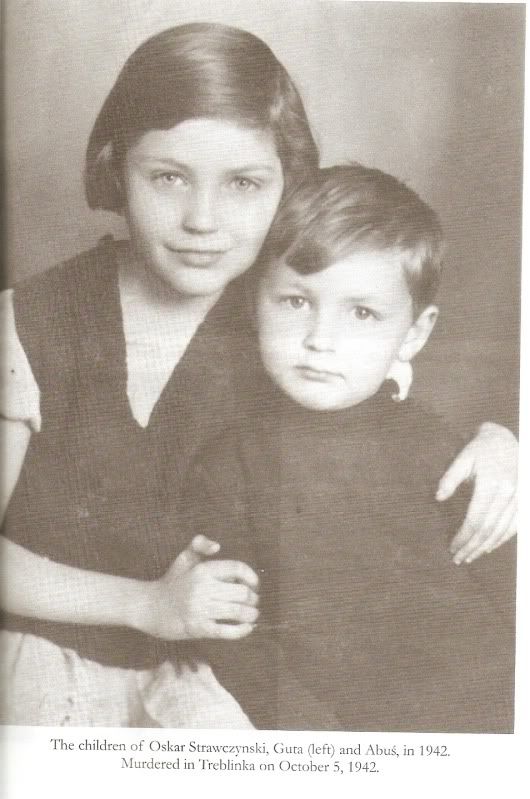
Let's take the example of the two little children shown on the photograph below, which was copied from the book Escaping Hell in Treblinka. Israel Cymlich. Oskar Strawczynski, edited by Yad Vashem and The Holocaust Survivors’ Memoirs Project, New York and Jerusalem 2007.


Guta (the girl) and Abus (the boy) were the children of Oskar Strawczyinski, a Jewish tinsmith from Lodz, and his wife Hannah (her husband called her Anka). This photo, also copied from the aforementioned book, shows their parents when they were married in 1932:


Guta was born in 1933, Abus in 1938. They were thus about 9 and 4 years old on 5 October 1942, when together with their parents, their grandparents they arrived at Treblinka extermination camp in a transport from the Polish city of Czestochowa. The arriving deportees were separated, men on one side, women and children on the other. Oskar Strawczynski was selected as a worker on account of his tinsmith skills, while his parents, wife and children were taken to "Camp 2", from where they never returned. What had become of them Strawczynski didn't take long to realize, the details of how people were killed in gas chambers in "Camp 2" and their bodies disposed of being later revealed to him by fellow inmates.

The source of the above information about the fate of Oskar Strawczynski's family is Oskar Strawczynski's memoir, the translation of which from Yiddish is partially transcribed after the aforementioned book, together with an introduction and biographical note from the same book, in my RODOH post # 11612. This is how Oskar Strawczynski, in his memoir written in a forest hideout during the spring and summer of 1944, described the last he saw of his loved ones:

It was the day after Sukkoth, October 5, 1942. The morning was bright and sunny. Although utterly exhausted after 24 hours in the tightly packed cattle cars, we shivered with terror when the train stopped and we heard frightful shouts: "Out! Out! …" Whips fly over our heads … In the eyes of my wife I recognize that finally even she has begun to believe the horrible rumors about the gas factory beyond Malkinia. I can see that now she regrets not having agreed to my plan to hide with the children in our neighbor’s hideout. She could not bring herself to believe all the malicious talk. She had wanted to believe that as long as we were together, no evil could reach her or our dear children.
We run out as fast as we can to avoid the whips lashing overhead and find ourselves on a long, narrow platform, crowded to capacity. All familiar faces – neighbors and acquaintances. The dust so tremendous, it obscures the sunlight. A smell of charred flesh stifles the breath. I catch a glimpse of the mountains of clothing, shoes, bedding and all kinds of wares that can be seen over the fence. But there is no time to think … The dense mass of people is pushed toward and jammed through a gate.
At this moment I have just one thought, not to lose my dearest ones in all this chaos. I succeed in keeping together with my wife, my two beautiful children, my mother and father. Little do I know that these are our last moments together, that behind the gate we would be torn apart and we would never see one another again.
[…]
Beyond the gate, we find ourselves in quite a large square with barracks on two sides. Opposite the fence and the gateway through which we had passed is a fence with a small entrance in the corner. This is the gate to the "Avenue of Death", which leads to the "baths" in Camp 2. Down this avenue, completely naked, they took their last walk: my dear wife and children, father, mother, brothers and sisters, together with millions of Jewish men and women. They never came out of the "bath". Their sacred bodies were heaped on stretchers and thrown into the infernal fires.
Later, when I was working on the rooftops of Treblinka, I had many opportunities to watch the last walk of our naked, unfortunate people: Mothers holding their little ones in the arms, older children at their sides, young girls with their hair already shorn, covering their breasts with their hands; or several together, arms linked, all running as quickly as possible through the row of Germans and Ukrainians, who laugh at them and mock them. Quite often, one or another of the victims was struck on the head with a whip or rifle butt and collapsed in a stream of blood. Those were horrible scenes from hell.
I return to the moment when we entered the so-called Transport Square. As we take our first steps, we hear shouts that freeze our blood. I stop thinking or feeling. We know only one thing. These are our last moments together. The shouts become louder and more penetrating: "Men to one side, women to the other."
We are completely confused by the lightning speed and terrible noise. I do not, I cannot, say a single word, not even a final farewell to my loved ones. I just hear the sigh of my beloved wife and her last words: "That’s it." No one can know how much despair and anguish those words contained. To me, they are the abyss of sorrow. I still hear those words ringing in my ears and I will surely not forget them to the last moments of my life.
Writing these words, I once again relive the sorrow of our parting. I cannot express the feelings raging within me. Fresh tears well up and the warm forest ground soaks up the hot stream from my eyes.
But there, on that sorrowful transport square, there is no time for tears or feelings. I scarcely have time to hand my wife the carefully hidden blanket for the children. A brutal hand grips my shoulder and I am hurled to the other side of the square. I manage to stay with my gentle father. The place is packed with people. On one side are women and small children; on the opposite side, men, forced to kneel. In the middle there are SS men, Ukrainians with weapons in their hands, as well as a group of about 40 men with red armbands. These are Jews, the detachment of "Reds." In Treblinka slang, they are called the "Hevra Kadisha" [Burial Society]
Kapo Jurek, the leader of the "Reds", had been a Warsaw rickshaw driver so corrupt and debauched, no deed was too foul for him. This brute would not hesitate to take aside a girl, already naked, on her march to the "bath". Promising to save her, he would do the worst, and then push her back into the line. He dressed elegantly, as that sort of person could easily afford to be in Treblinka. He works his whip on Jewish heads frequently and with gusto. As foul and corrupt as he was, his language was even worse. The vernacular of the Warsaw underworld was nothing new in Treblinka. There were great artists in that field, but no one could surpass Jurek. In short, he was quite a notable member of Treblinka’s aristocracy. Most of the "Reds" were recruited from the Warsaw underworld and did not fall short of their Kapo.
Most prominent among all in the square is a German officer, a stout man with a trimmed beard, mounted on a beautiful brown horse. He moves haughtily on his horse in the middle of the square. At a certain point, he turns towards the kneeling men and shouts: "Craftsmen, out!" A number of men step forward. Most of them, however, are sent back. Only a few are taken aside, where an SS man makes a further selection, and divides the remaining men into groups of three. I am kneeling beside my father. My mind is completely blank. No feeling, not a thought. I do not even say a single word to my father.
Among the men with the red armbands, I notice a familiar face. At first I cannot recall who he is, but then I recognize him. It is Aaron Berliner, a worker from the Czestochowa Jewish Community. He too has noticed me. He motions me to come over to him. I stand up, take my father's hand and try to take my bundle as well. He orders me to leave my bundle, and orders my father to kneel as before. Aaron leads me to the mounted German. The German looks me over and asks: "What’s your trade?" "Tinsmith," I say. He motions me toward the selected group, to which Aaron leads me. Now I am completely alone, also parted from my father, without a kiss, without a single farewell …
The group grows to about 60 men, no women. A man of about 30 approaches us. He is tall and broad with strong muscular legs and black hair, a young giant. This is Kapo Rakowski. He shouts a command and leads us away in military formation. As we march through the remaining mass of people, I scan the women’s side. Perhaps I can catch a last glimpse of my loved ones; perhaps I will see my two little angels again. I do not find them; probably they are in the barracks.
We are led to an enormous square, piled with mountains of bundles. In the distance is a tall embankment on which a watchman saunters back and forth, his rifle at the ready. From behind the embankment, thick smoke bursts forth as if from a volcano.
[…]
The crowd passes through and there is silence for a few minutes. Suddenly a smothered mass scream is heard from the distance. "Ah-ah-ah…" The scream does not last long; it becomes weaker and weaker until it dies away. I know instinctively that this is the last cry of the unfortunate, condemned victims, among them my own, my loved ones. Again I break into hysterical tears.
After every transport I heard this same last cry, which makes by blood run cold.


Like other survivors separated from their families upon arrival in an extermination camp, Oskar Strawczynski didn't see his wife, children and parents die in the gas chambers. But there could be no doubt for him that they were dead, because he never saw them again after they were taken to "Camp 2", because he saw the smoke of the fires burning in "Camp 2" and smelled the stench of burning flesh, and because fellow inmates who had worked in "Camp 2" later described to him what he briefly mentioned in the above-quoted passage and later in more detail, i.e. how the people taken to "Camp 2" were killed and their bodies disposed of:

While we in Camp I were busy building and beautifying, the work of exhuming and burning the bodies of the first victims of the Warsaw ghetto continued intensively in Camp 2. There were a few tremendously huge mass graves, each one filled with tens of thousands of murdered people. The layers of corpses were covered with chlorine. At the beginning, the chlorine used to arrive in wagonloads. The bodies were now being dug out and burnt in order to erase the evidence. It was not an easy job. For many months, three bulldozers growled away from 4 o'clock in the morning until nightfall. The work went on with great intensity, in two shifts. The bulldozers would constantly dig up earth mixed with body parts. The body parts had to be carefully picked out and taken on wooden carriers to be burnt in the great ovens. When one of the mass graves was emptied, the earth was replaced and carefully smoothed over, to give the appearance that nothing had ever been there. The Germans would celebrate by bringing whiskey and drinking a toast – "Until the last Jew" – and would finish up with a three-gun salute.
The graves could never be emptied entirely, because blood mixed with water accumulated at the bottom. Motorized pumps were set up to draw it out. However, they could never manage to drain the bottom few meters, and so the graves were simply covered over.
Over in Camp 2, there was also the bath … It was a large, concrete building standing on a cement platform. On its roof, visible from a distance, was a wooden Star of David. Running through the middle of the building was a corridor. The entrance was covered with a red curtain. Off the corridor were doors leading to small cubicles into which the arrivals from the transport were introduced. Outside, over the platform were large openings covered by panels hinged at the top and fastened with steel bands. Inside the cubicles, smooth tiles covered the slightly slanted floors and halfway up the walls. On the ceiling were mounted a few shower-heads. There was also a small window in the middle of the ceiling [of each cubicle].
As mentioned before, the people leave all their belongings in Camp 1. Everyone is undressed there. The women, already naked, are seated on a long bench and their hair is cut off. This is accomplished by about 40 barbers. The hair is then cleaned with steam, using a steam kettle brought especially for this purpose. The hair is then packed in bales, and sent out along with the clothing and other wares.
The victims come into Camp 2 already naked and shorn, and are immediately squeezed into the cubicles. There is no more division. Men, women, and children are all pressed together in the small cubicles so tightly that this alone would be enough to suffocate them. The doors are hermetically sealed, and the motors start to work. The air from inside is sucked out, and fumes from burnt gasoline are forced in. The cries from inside can be heard for about 10 minutes, and then it becomes silent. The entire process, from the arrival at the camp to the oven, lasts only about half an hour. Most of the victims in the cubicles start to hemorrhage.
A German controls the progress of the "work" through the little window in the ceiling. When he is sure that everyone inside is dead, he opens the side panels, and the corpses fall out onto the cement platform. An elderly Jew from Czestochowa, known as "the dentist", checks the bodies for gold or metal teeth, which he pulls out. The bodies are then piled onto stretchers and carried to the oven, where they are flung into the fire and burned. The blood that has collected in the cubicles streams out into specially dug ditches.
The "bath" contained 10 cubicles: four big ones and six smaller ones.
As I mentioned before, we in Camp 1 were strictly forbidden to enter Camp 2. If anyone crossed over into Camp 2 by accident, that's where he had to remain; there was no return to Camp 1. I received the information about the arrangements and procedures in Camp 2 mainly from Herszel Jablkowski, a solid and decent man, with whom I worked for many months in the workshop; he as a [black]smith and I as a tinsmith. He arrived at Treblinka on June 18, 1942, a considerable time before the first transports. According to him, the first transport arrived on Tisha B’Av in 1942 (July 23). He participated in digging the first mass grave. At that time, there was no bulldozer. Later, as a smith, he was employed in building the "bath". It was all one camp then. The day before the first transport arrived, Camp 1 and Camp 2 were divided. As a skilled tradesman, Jablkowski was sent to Camp 1. I also received some information about Camp 2 from Szymon Goldberg, a carpenter from Radomsko, who worked in Camp 2 for four months. He escaped during the uprising and we met in the forest 10 months later.


Oskar Strawczynski's above-quoted descriptions of what he experienced himself as an inmate in "Camp 1", and of what he learned from Jablkowski and Goldberg about procedures in "Camp 2", are generally accurate. His description of the gas chamber building's features, for instance, tallies with descriptions provided by other eyewitnesses (inmates, Ukrainian guards or SS supervisors) independently of Strawczynski. His express mention of three "bulldozers" (probably a mistaken translation of the Yiddish term used by Strawczynski to describe the excavators shown on photographs taken by Treblinka’s second-in-command Kurt Franz - corroborates and is corroborated by Alex Bay's analysis of Kurt Franz’s photographs in Bay's article The Reconstruction of Treblinka, namely the following conclusion (my emphasis):

The most basic fact that can be determined from the ground photos is that there were two, and probably three excavators in use at Treblinka. (see Figure 40).


And it is noteworthy that Strawczynski and his sources were among the few witnesses to mass murder in Treblinka who realized that the gassing was done with gasoline exhaust and not – as described by several other Treblinka witnesses – with diesel exhaust.

There are also some inaccuracies in Strawczynski's above-quoted account. Witnesses are usually not perfect observers, especially when it comes to traumatically violent events, and Strawczynski was no exception to the rule. Thus, for instance, he had an exaggerated idea of the number of Treblinka’s victims (estimated as at least 731,600 by the Central Commission for Investigation of German Crimes in Poland and at least 780,863 by Polish historian Jacek Andrzej Młynarczyk), unless he was referring to Nazi extermination camps in general when he wrote that his family had taken "their last walk" down the "avenue" to the gas chambers "together with millions of Jewish men and women". But then, how could any Treblinka inmate have made a fairly accurate estimate of the number of people killed in Treblinka? One should also bear in mind that many people have no precise notion of the meaning of numbers and may thus use the term "millions" not in a literal sense but just to convey the idea of an enormous order of magnitude. (This applies even to some historians, according to Matthew White, who in research for his Historical Atlas of the Twentieth Century occasionally got the feeling «that some writers use numbers as pure rhetorical flourishes. To them, "over a million" does not mean ">106"; it's just synonymous with "a lot"»). Oskar Strawczynski and his sources may also be forgiven for having mistakenly assumed that the air was sucked out of the gas chambers before "fumes from burnt gasoline" were forced in (what actually happened, as pointed out by the editor of Strawczynski’s memoirs in a footnote, was that the effect of pumping the poisonous exhaust into the gas chambers was to replace the air there). And it is not a mistake at all that they referred to the roasters used for burning the corpses as "ovens". It is a mere difference in lexicon: survivors would often call the pyres in Babiy Yar, Sobibor and elsewhere "crematoria", "ovens" and "furnaces", all the while describing them as pyres (thanks to Sergey for this input). Ukrainian guard Pavel Vladimirovich Leleko talked about "furnaces", and yet his detailed description of the devices used to burn the corpses at Treblinka helped me to accurately reconstruct the features of these devices, especially as concerns the presence of a pit underneath the rails on which the bodies were placed, in which the fire to make the corpses burn was ignited (see the blog Belzec Mass Graves and Archaeology: My Response to Carlo Mattogno (4,2)).

In sum, what inaccuracies are contained in Oskar Strawczynski’s account of his arrival at Treblinka extermination camp and the killing and body disposal procedures at that place are no reason to put in question the essential accuracy of that account. The stated date on which the Strawczynski family arrived at Treblinka from Czestochowa, 5 October 1942, can be checked against the evidence used by Yitzhak Arad to put together the deportation statistics in his book Belzec, Sobibor, Treblinka. The Operation Reinhard Death Camps, according to which about 40,000 Jews were deported to Treblinka from Czestochowa between 21 September and 5 October 1942. There is no indication whatsoever that Strawczynski's parents, his wife Hannah and his children Guta and Abus survived the war, or that they got out of Treblinka alive, or even that they survived the day on which Strawczynski last saw them. Thus the only argument that "Revisionists" might have to dismiss Strawczyinski’s account as a collection of lies and Strawczynski as a "lie-witness" ("Revisionists" are fond of such idiotic word concoctions) would be some evidence that Strawczyinski was a person prone to telling lies, and moreover a liar so degenerately immoral as to falsely claim the murder of his wife and his two little kids. Is there such evidence?

The best place to find such evidence would be an assessment of Strawczyinski's testimony at a trial held before a court of a constitutional state according to a constitutional state's defendant-friendly procedural rules, in which such court as well as prosecutors and defense attorneys had the opportunity to gain a first-hand impression of Strawczyinski as a witness and to cross-examine him as they considered necessary. Oskar Strawczyinski testified as a witness at the trial of Kurt Franz and others before the Düsseldorf District Court. So, what does that court's judgment tell us about Oskar Strawczyinski behavior when testifying and his reliability as a witness?

I translated the following excerpts from the judgment (emphases are mine):

During an evening roll-call SS-Hauptscharführer Küttner called the number of an inmate who had for some reason caught his attention during the day. The inmate was tied to the beating rack and beaten by Küttner and the defendant Franz on the naked behind. Thereafter Franz and Küttner announced that this inmate would be shot in the Lazarett. At their orders the beaten man was then immediately brought to the Lazarett and shot there. This incident, which was described by the witness Oscar Stra. under oath, has been established to the jury court's conviction. The witness Oscar Stra. made an objective, truth-loving impression on the court. He immediately recognized the defendant Franz. As he also said favorable things about some of the German guards, such as the defendant Suchomel, there is no reason for assuming that he could subjectively or objectively have said something false. Although the witness did not himself see the shooting in the Lazarett, this has also been established to the court's conviction. That the beaten man was in fact liquidated in the Lazarett is suggested by the fact that Franz and Küttner announced his imminent shooting during the evening roll-call. Besides the witness never saw the man again after that evening roll-call. As the Lazarett was a place where people were shot in the neck, this only allows for the conclusion that the beaten man was shot there.


Although Miete denies this deed, it is proven by the testimony under oath of the 58-year-old tinsmith Oscar Stra. from Montreal, who himself witnessed how Miete addressed Galitzarski, selected him and took him to the Lazarett. On the other hand the witness didn’t see the shooting proper in the Lazarett. Yet he pointed out that he thereafter never again saw Jakob Galitzarski, who was a personal acquaintance of his, in the camp. This allows for concluding that Miete actually killed this inmate. In any case the extensive taking of evidence made known no case in which an inmate taken by Miete to the Lazarett for shooting remained alive.
The witness Oscar Stra. correctly described the German camp personnel, especially including the defendant Miete, and the camp's installations. He strictly distinguished between what he had observed himself and what he had been told by other inmates. As he reinforced his quiet and objective deposition with the oath, there are no misgivings about giving him credence.


These findings of fact are based on the defendant’s deposition, insofar as it can be accepted as accurate, and on the testimonies under oath of the credible witnesses Gl., Un., Do., Raj., Oscar Stra., Pla., Sed., Ku., Wei., Au. and Lew.


In his interrogation under oath the tinsmith Oscar Stra. accurately expounded that Suchomel made an effort for better feeding of the gold and court Jews and that he treated them well within the range of his possibilities. As Oscar Stra. was himself a court Jew he can correctly judge this. The witness finally pointed out that Suchomel was called "the good German" by the gold and court Jews, a designation that according to the results of the taking of evidence was given to no other German SS-men by the witnesses.

The witness Su. was furthermore certainly mistaken insofar as she stated that Suchomel "very often" beat inmates on the roll-call square. Many reliable witnesses, among them Gl., Un., Pla., Oscar Stra., Raj. and Wei., declared the contrary, that Suchomel never beat anyone outside the processing of transports.


Suchomel denies to have killed one or even more of the gold Jews. He points out that during his stay in Treblinka of the small detachment of gold Jews only the gold Jew Stern was killed, for which he could not be held responsible (see Section A.VI.15. of Part Two of the reasons for the judgment, where the death of gold Jew Stern is described).
This defense of the defendant Suchomel is confirmed by the witnesses Oscar Stra., Gl., Tai., Koh., Sed. and Lew., all of whom the jury court considered especially reliable.


That Suchomel treated his gold and court Jews well is proven by the sworn witnesses Gl., Un., Do., Raj., Oscar Stra., Pla., Sed., Ku., Wei., Au. and Lew. and has been already demonstrated in detail in Section F.II.2. of the Second Part of the reasons for the judgment. On the other hand is has been described in detail in Section F.II.1., on hand of the depositions of the witnesses Gl., Tu., Kols., Oscar Stra., Do., Tai. and Koh., interrogated under oath, that Suchomel could also be brutal during the processing of the transports, by beating the Jews who had arrived and were meant for extermination with the whip and in a few cases also using his firearm, in order not to be considered by his superiors and comrades a weakling and loser.


These are not the only mentions of Oskar Strawczyinski in the judgment, but I think they are sufficient to show that the court had a most favorable impression of this witness as an objective and fair man who differentiated between the horrors he had experienced and the gentler behavior of some SS-men, namely the defendant Suchomel. Strawczyinski’s care in distinguishing between what he had seen or heard himself and what he had learned from others also shows in the above-quoted excerpts from his memoir, in which he expressly mentioned the sources of what he knew about "Camp 2".

So what we have is the memoir of someone who everything indicates to have been a highly reliable witness, which includes a first-hand description of how that witness's loved ones were separated from him and taken to a place from which they never returned, which was part of a camp that all known evidence – including but not limited to that witness’s memoir and testimony and to other evidence listed in my VNN posts nos. 172, 194,777 and 1825 and in previous posts on this blogspot – shows to have been an extermination camp for Jews, a place where Jewish people were taken for no other purpose than to be killed there, mainly by gassing in the part of the camp to which the members of Oskar Strawczyinski's family were taken.

That being so, what reason is there not to consider it proven beyond a reasonable doubt that Oskar Strawczyinski’s parents, his wife Hannah and their children, nine-year-old Guta and four-year-old Abus, were killed in a gas chamber at Treblinka on 5 October 1942?

"Revisionists" may want to seek refuge in the formal-legalistic argument that the late Oskar Strawczyinski's memoir would not be admissible as evidence in court, so let’s take a look at whether this is really so.

Section 250 of the German Criminal Procedure Code(Strafprozessordnung - StPO) establishes the rule whereby, if the proof of a fact is based on the observation of a person, such person shall be examined at the main hearing, and the examination shall not be replaced by reading out the record of a previous examination or reading out a written statement. The reason for this rule is obvious: as concerns assessment of a witness account's credibility, nothing beats the court's gaining a first-hand impression of the witness through direct, face-to-face interrogation. Therefore, directly interrogating the witness is what must be done if it is possible. However, sometimes direct interrogation by the court is not possible, because the witness is no longer alive or because there are insurmountable hindrances to the witness's appearing in court. For such cases, Section 251 of the StPO contains the following provisions, among others:

(1) Die Vernehmung eines Zeugen, Sachverständigen oder Mitbeschuldigten kann durch die Verlesung einer Niederschrift über eine Vernehmung oder einer Urkunde, die eine von ihm stammende schriftliche Erklärung enthält, ersetzt werden,
1. wenn der Angeklagte einen Verteidiger hat und der Staatsanwalt, der Verteidiger und der Angeklagte damit einverstanden sind;
2. wenn der Zeuge, Sachverständige oder Mitbeschuldigte verstorben ist oder aus einem anderen Grunde in absehbarer Zeit gerichtlich nicht vernommen werden kann;
3. soweit die Niederschrift oder Urkunde das Vorliegen oder die Höhe eines Vermögensschadens betrifft.


My translation:

(1) Interrogation of a witness, expert or co-accused can be replaced by the reading of an interrogation record or a document containing a written statement of the witness, expert or co-accused in question,
1. If the defendant has a defense attorney and the public prosecutor, the defense attorney and the defendant agree to it;
2. If the witness, expert or co-defendant have died or for some other reason cannot be interrogated by a court within a foreseeable time;
3. Insofar as the record or document concerns the occurrence or the amount of a pecuniary damage.


Alternative 2 is the one that applies here. As Oskar Strawczyinki is dead (he died in 1966) and his memoir is a written statement of his, it would be permissible to read the memoir into evidence at a present-day criminal trial before a German court.

In Anglo-Saxon legal systems there is the so-called hearsay rule, which is guided by more or less the same reasoning that underlies Section 250 of the StPO:

The theory of the rule excluding hearsay is that assertions made by human beings are often unreliable; such statements are often insincere, subject to flaws in memory and perception, or infected with errors in narration at the time they are given. The law therefore finds it necessary to subject this form of evidence to "scrutiny or analysis calculated to discover and expose in detail its possible weaknesses, and thus to enable the tribunal (judge or jury) to estimate it at no more than its actual value".[3]


Rule 801 of the US Federal Rules of Evidence defines hearsay as «a statement, other than one made by the declarant while testifying at the trial or hearing, offered in evidence to prove the truth of the matter asserted». Strawczyinski's memoir would thus qualify as hearsay if it were to be introduced at a trial or hearing as evidence to the facts we are concerned with here – the death of Oskar Strawczynski's family members at Treblinka extermination camp –, and according to Rule 802 it would thus be inadmissible as evidence to these facts at such trial or hearing unless any of the hearsay exceptions provided for in Rules 803, 804 or 807 applies.

Rule 803 contains exceptions to the hearsay rule that would make the introduction of Oskar Strawczyinski's memoir as evidence admissible even if he were alive and available to testify at the trial or hearing in question. My understanding is that the exceptions that could possibly or arguably apply in this case are the following:

(5) Recorded recollection: if Oskar Strawczynski were available to testify but presently had insufficient recollection of the events in question;
(16) Statements in ancient documents. Statements in a document in existence twenty years or more the authenticity of which is established: Oskar Strawczynski’s memoir was written more than sixty years ago, and its authenticity is established and could be specifically confirmed for the trial or hearing in question by expert examination or by the testimony of Strawczynski or a family member familiar with the memoir;
(19) Reputation concerning personal or family history. Reputation among members of a person's family by blood, adoption, or marriage, or among a person's associates, or in the community, concerning a person's birth, adoption, marriage, divorce, death, legitimacy, relationship by blood, adoption, or marriage, ancestry, or other similar fact of personal or family history: Oskar Strawczyinski's parents, wife and children are reputed dead by Oskar Strawczynski, as expressed in the memoir.

But Oskar Strawczynski is dead, so it's moot to ponder what hearsay exceptions would apply if he were alive and able to testify about the murder of his family. The memoir clearly qualifies as an exception to the hearsay rule according to the following provision of Rule 804 (emphasis mine):

(4) Statement of personal or family history. (A) A statement concerning the declarant's own birth, adoption, marriage, divorce, legitimacy, relationship by blood, adoption, or marriage, ancestry, or other similar fact of personal or family history, even though declarant had no means of acquiring personal knowledge of the matter stated; or (B) a statement concerning the foregoing matters, and death also, of another person, if the declarant was related to the other by blood, adoption, or marriage or was so intimately associated with the other's family as to be likely to have accurate information concerning the matter declared.


The makers of the FRE obviously considered information about the death of blood relatives or other family members to be generally trustworthy.

Even if none of the hearsay exceptions according to Rules 803 or 804 applied, Strawczynski's memoir could still be admitted as evidence at a US trial or hearing according to Rule 807.

So it doesn't look like either the German Criminal Procedure Law or the US Federal Rules of Evidence would keep a competent court under either legal system from accepting Oscar Strawczynski's memoirs as evidence to the death of Oscar Strawczynski's family members at Treblinka extermination camp.

It's also not like names of victims of the Nazi genocide of the Jews – whether killed in extermination camps, by mobile killing squads or by other means – are a rarity, even though the identity of millions of victims remains to be established. The percentage of Jewish mass murder victims whose names are known differs considerably among the various countries of origin, depending on how complete the records available in each country are and what effort authorities and researchers in a given country made to establish the identities and individual fates of their Jewish citizens killed by the Nazis (see Dr. Nick Terry’s article Arolsen: AAARGH, all those names.... for details).

The Dutch authorities did the best job in this respect: they managed to record the names of all Jewish citizens of the Netherlands killed by the Nazis, mostly in extermination camps. Auschwitz-Birkenau was the main destination of Jewish deportees from the Netherlands, but a total of 34,313 Dutch Jews arrived at Sobibor in 19 trains between 5 and 6 March and 23 July 1943. 18 survived. To what extent the individual fate of these and other deportees to Sobibor has been reconstructed is becoming apparent these days at the trial against John Demjanjuk before the Munich District Court, as the following translated excerpts from articles in SPIEGEL magazine may illustrate. Emphases are mine.

From the article Mutmaßlichem Massenmörder Demjanjuk droht Anklage in Deutschland:

Demjanjuk is accused of having during the time of his service participated in the murder of at least 29,000 Jews – most of them women, children and old people. Almost all were killed still on the day of their arrival.

Among the victims – and this is important for an eventual indictment in Germany – there were about 1,900 German Jews. "Due to the charges we are confident that a trial against him can be held in Germany", says Schrimm. It is now possible for the first time, according to Schrimm, to mention the victims with their complete name and birth date. The eldest victim, who died on 23 April 1943 in the gas chambers, had been a 99-year-old Jew from Holland. In all deportation trains, according to Schrimm, there were babies and little children, who were gassed immediately after arrival at Sobibor.


From the article "Die Menschen sollen nicht vergessen":

19 of the joint plaintiffs have been called as witnesses and will travel to Munich when the trial begins. If things go according to plan they shall be heard within the first three days of the trial.

Others follow the trial from far away, in the Netherlands, in the USA, in Switzerland or Israel. All joint plaintiffs have lost close relatives, parents, brother and sisters or spouses, sometimes the whole family. According to the recovered transport lists they died in Sobibor extermination camp in occupied Poland, murdered in those months of the year 1943 in which Demjanjuk was presumably used there as guard by the SS.


From the article "Gefühllose und unbarmherzige Gesinnung":

The opening of the taking of evidence starts, over many minutes the Presiding Judge reads out names, birth and death dates of Jewish men and women who were deported in 1943 from the camp Westerbork in the Netherlands to Sobibor. There are many names, each one of them is a close relative of the joint plaintiffs, fathers, mothers, brothers, sisters. Some joint plaintiffs wince when the names of their relatives are read.


And then there are folks asking "Can you give the name of just one Jew, with proof, who was gassed?", as if that were a clever and pertinent question ...
Wider Two Column Modification courtesy of The Blogger Guide / HCS